

Parent Teen Communication often becomes the biggest challenge when a child enters adolescence – and that’s exactly where Kavitha found herself.
Kavitha had handled many roles in her life – a working professional, a wife, a daughter-in-law, and a mother.
But one role confused her the most lately: being a mother to a teenage daughter.
Her daughter Anu had changed.
Short answers. Closed doors. Phone always in hand.
Every conversation seemed to end in silence or an argument.
“I do everything for her,” Kavitha said softly when she met Dr. Ananya again.
“But she barely talks to me now. Where did I go wrong?”
Dr. Ananya smiled gently.
“You didn’t go wrong, Kavitha. This is not a generation gap, it’s a communication gap. And the good news? It can be fixed.”
Anu sat quietly beside her mother as Dr. Ananya spoke.
“Most parents think teens don’t talk because they belong to a different generation,” Dr. Ananya explained.
“But the real problem is not age, it’s how we talk to each other.”
 What Parents Often Feel
 What Parents Often Feel
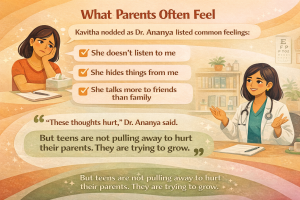
Kavitha nodded as Dr. Ananya listed common feelings:
- “She doesn’t listen to me.”
- “She hides things from me.”
- “She talks more to friends than family.”
“These thoughts hurt,” Dr. Ananya said,
“But teens are not pulling away to hurt their parents. They are trying to grow.”
What Teens Often Feel (But Don’t Say)
Dr. Ananya then looked at Anu and said gently:
- “I feel judged.”
- “I feel lectured.”
- “I feel misunderstood.”
- “I don’t feel safe sharing.”
Anu looked surprised.
“It feels like you’re reading my mind.”
Dr. Ananya smiled.
“Teen emotions are universal.”
Why Conversations Turn Into Conflicts
Dr. Ananya explained simply:
- Parents speak from fear
- Teens hear control
- Parents want to protect
- Teens want independence
“When intentions clash, communication breaks,” she said.
Q&A
Q1: Is it normal for teenage girls to talk less to parents?
Yes. It’s part of growing up, not rejection.
Q2: Does strict parenting stop communication?
Yes. Fear closes conversations.
Q3: Can communication improve after fights?
Absolutely. Repair matters more than perfection.
Listening Is More Powerful Than Talking
Kavitha sighed,
“I talk to her all the time. But nothing changes.”
Dr. Ananya replied calmly,
“Talking is not the problem. Listening is missing.”
What Is Active Listening?
Dr. Ananya explained in simple words:
Active listening means:
- Giving full attention
- Not interrupting
- Not judging
- Not rushing to fix
“It’s about understanding, not correcting,” she said.
Common Listening Mistakes Parents Make
Dr. Ananya gently pointed out:
- Interrupting with advice
- Comparing with others
- Minimizing feelings (“It’s nothing”)
- Turning talks into lectures
Kavitha smiled sadly.
“I do all of that.”
Dr. Ananya smiled back.
“Most loving parents do.”
How Active Listening Builds Trust
Dr. Ananya gave Kavitha simple steps:
- Put the phone away
- Maintain eye contact
- Say, “I hear you”
- Ask open questions
- Pause before replying
“When teens feel heard,” she said,
“they open up more.”
Anu nodded quietly.
Q&A
Q1: Should parents always agree with teens?
No. Understanding comes before correcting.
Q2: How long should parents listen?
Until the teen feels understood.
Q3: Does listening really change behavior?
Yes. Feeling heard reduces rebellion.
Why Teenage Girls Talk More When They Feel Heard
Anu finally spoke up.
“Doctor… sometimes I want to talk, but I’m scared it will turn into a lecture.”
Dr. Ananya nodded.
“That fear shuts doors.”
Why Feeling Heard Matters So Much
Dr. Ananya explained:
- Teens are forming identity
- They question themselves daily
- They need emotional safety
“When parents listen without judgment,” she said,
“teens feel safe to share.”
Building Trust With Teens, One Conversation at a Time
Dr. Ananya shared practical mother-daughter relationship tips:
- Choose calm moments to talk
- Start with curiosity, not control
- Say “Help me understand”
- Accept silence sometimes
- Appreciate honesty, even when it’s hard
“These small actions build trust,” she said.
What Kavitha Learned That Day
Kavitha took a deep breath.
“I thought good parenting meant correcting every mistake.”
Dr. Ananya smiled gently.
“Good parenting means staying connected, even during mistakes.”
Anu looked at her mother and smiled slightly.
That small smile meant everything.
Q&A
Q1: How can I rebuild trust if it’s already broken?
Start with listening and honest apologies.
Q2: Should mothers share their own feelings too?
Yes. It makes communication equal and real.
Q3: How often should parents talk to teens?
Regularly, but without forcing conversations.
Conclusion
If you’re wondering how to talk to your teenage daughter, remember this:
- Teens don’t need perfect parents
- They need present parents
- Listening builds trust
- Trust opens conversations
As Kavitha and Anu left the clinic, something felt lighter.
No big solutions.
No strict rules.
Just a new understanding.
Kavitha smiled and said softly,
“Maybe I don’t need to talk more. Maybe I need to listen better.”
Dr. Ananya nodded.
“That’s how conflict turns into connection.”
Have you ever felt disconnected from your teenage child, even though you deeply care?

0 Comments